I enjoyed Venice for the most part. It was small and quaint and the crowds weren’t as intense as many places we visited. We could actually get a glimpse and feel of local life rather than just a blast of tourist kitch.
Our rental was on the second and third story above a shop. The second floor was the tiny kitchen and one bedroom and the third floor the bathroom and another bedroom. Then there was a steep narrow ladder that led up to a tiny roof top deck. Our travel companion was not very trusting of the construction and refused to sit up there with us. I figured if it had clung to the roof for this long, it was likely to continue doing so.
These are some of the pictures I took from that vantage point.
One of my best photos is of this lone accordion player. He sat in that spot for a couple of hours every afternoon/evening and really put the final touches to the Italian ambiance.
This was a great spot to watch the life of Venice. We were off the main route to the tourist hotspots, so we saw a more casual group of people.
There was a small restaurant just a few doors down and the crowd was lively until almost 2am every night. Lively but enough to keep me awake. It was more like atmosphere. I know for a fact that I fell asleep with a smile on my face
We are back from our world travels and have recovered for the most part. It takes three or four days to really get back into your normal sleep pattern and home routine. I’m 95% back to normal and ready to get some work done.
I have yet to crack open my novel but am working up to it. I have some great ideas for later and will get to it eventually. For now, I need to get back into the day-job routine and make sure the I still have a income.
I have a total of 3302 pictures and videos to sort and edit from the trip and have barely scraped the surface. I will add a few here as a teaser. Keep in mind these are just taken with my cellphone. I haven’t posted any pics from the big camera and have high expectations.
Venice does not smell like a ditch – pleasantly surprised
I have failed to find ANY bad Italian food!
There are millions of steps here! My legs are tired.
The traffic is INSANE!! But I think every single Italian is a better driver than every American. I saw no accidents.
There are no malls. But there are little shops and restaurants on every corner.
I never saw a straight road.
The seafood here is amazing.
We found an Irish pub in every town we stopped in. I don’t need a Guiness every day, but I want to know where to get one when the need arises.
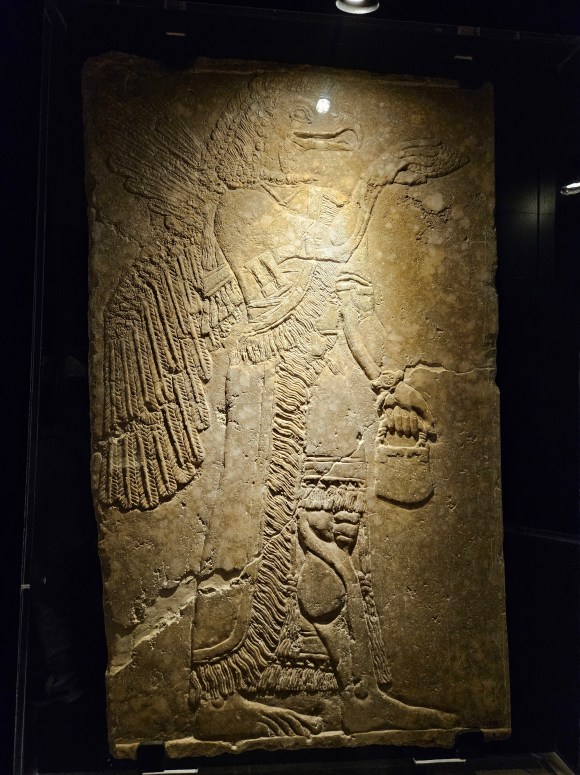
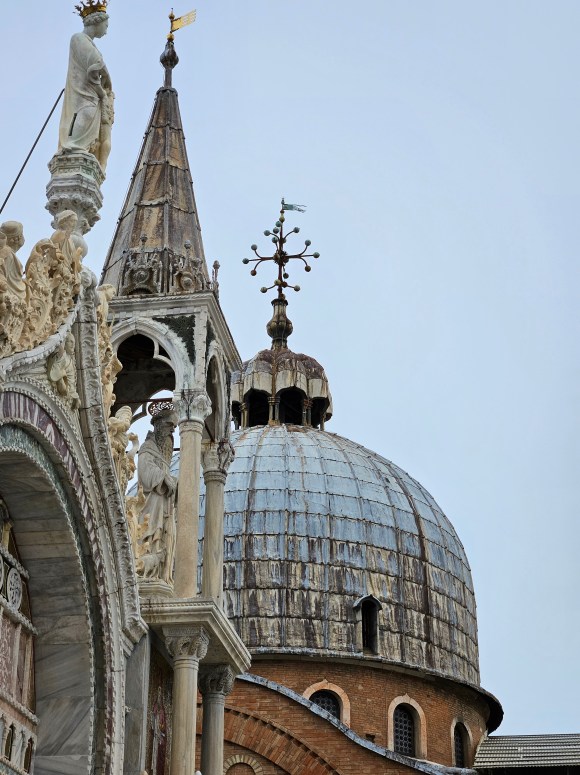
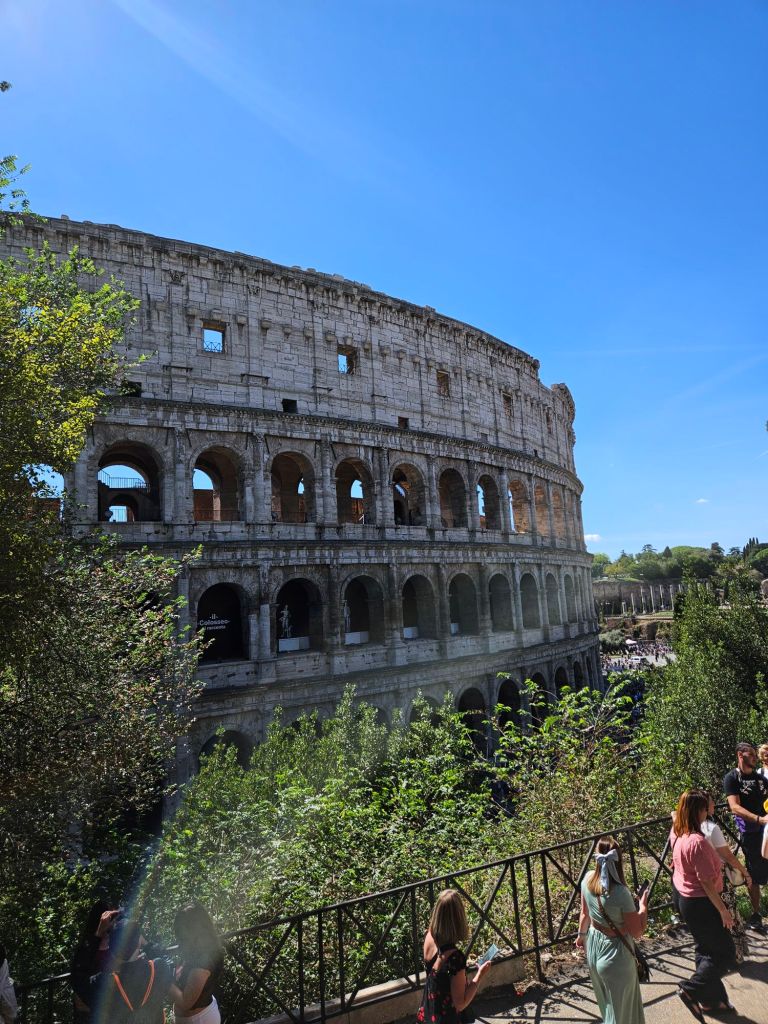
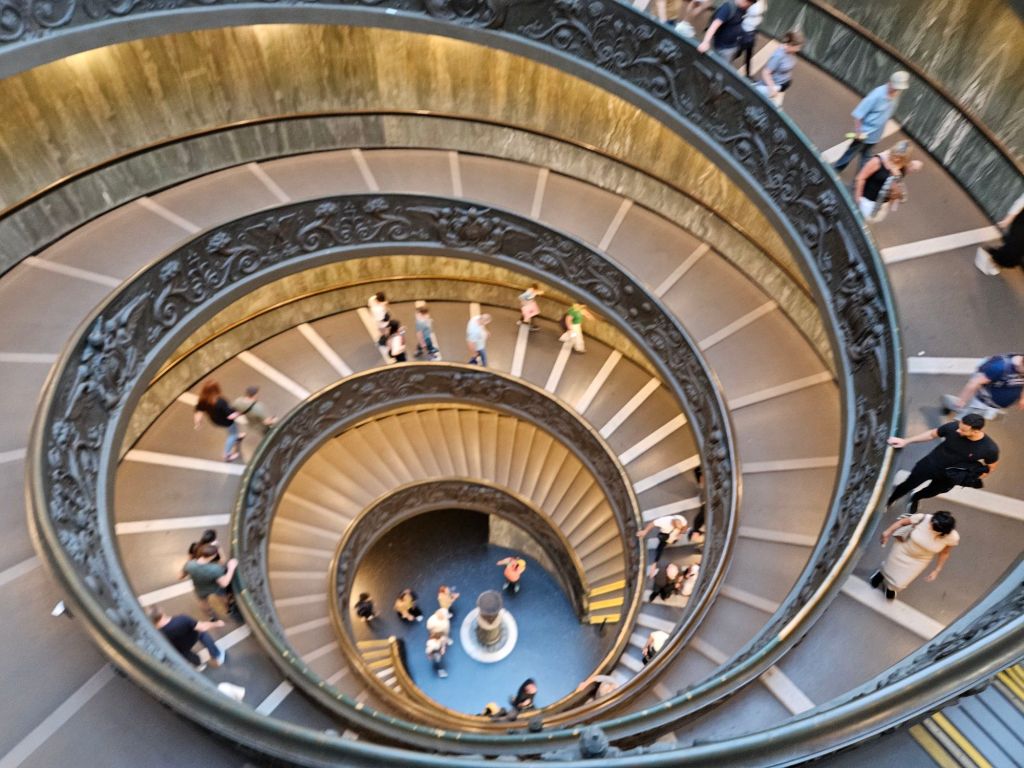
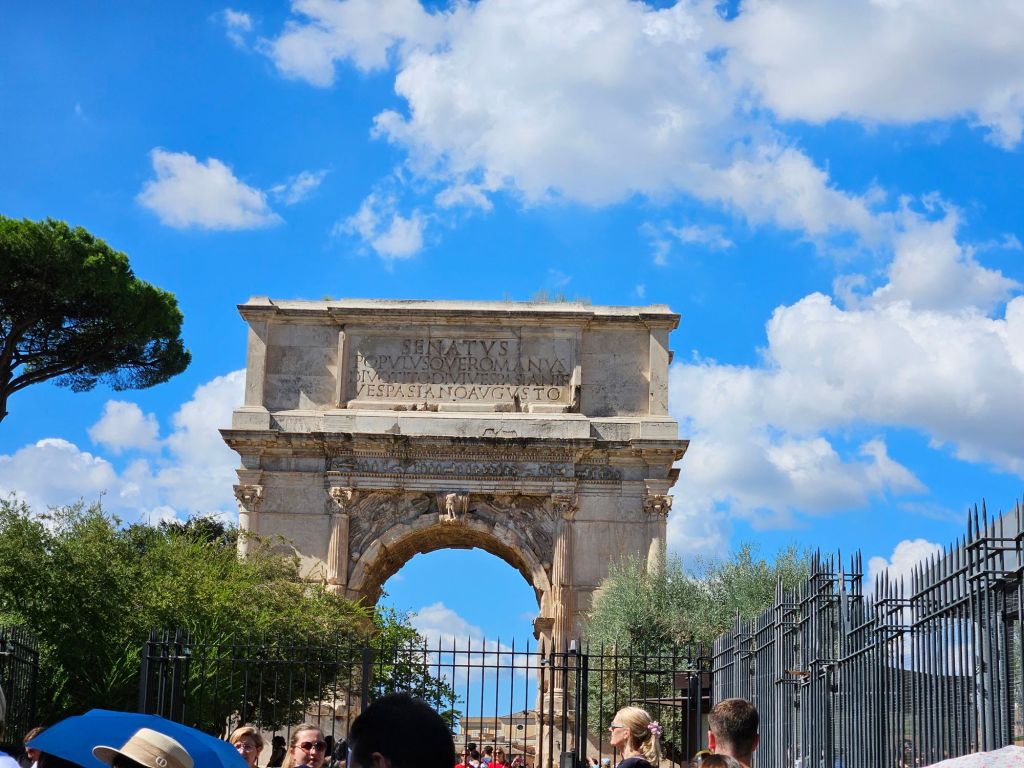
Venice by gondolaSpanish steps in RomeRoman ColoseumStolen Egyptian artifacts at the Vatican MuseumsDome of Vatican MuseumsExit of Vatican MuseumsColosseum and ForumSolerno
My very first experience of international travel was to Salzburg, Austria. I was working for an Austrian company, and they sent me to the headquarters in Salzburg for training. I studied German in both high school and college but had never tried it live – so to speak – and was excited. I was traveling with several other Americans, several of who had made the trip before. But I was the only one with any German skills at all.
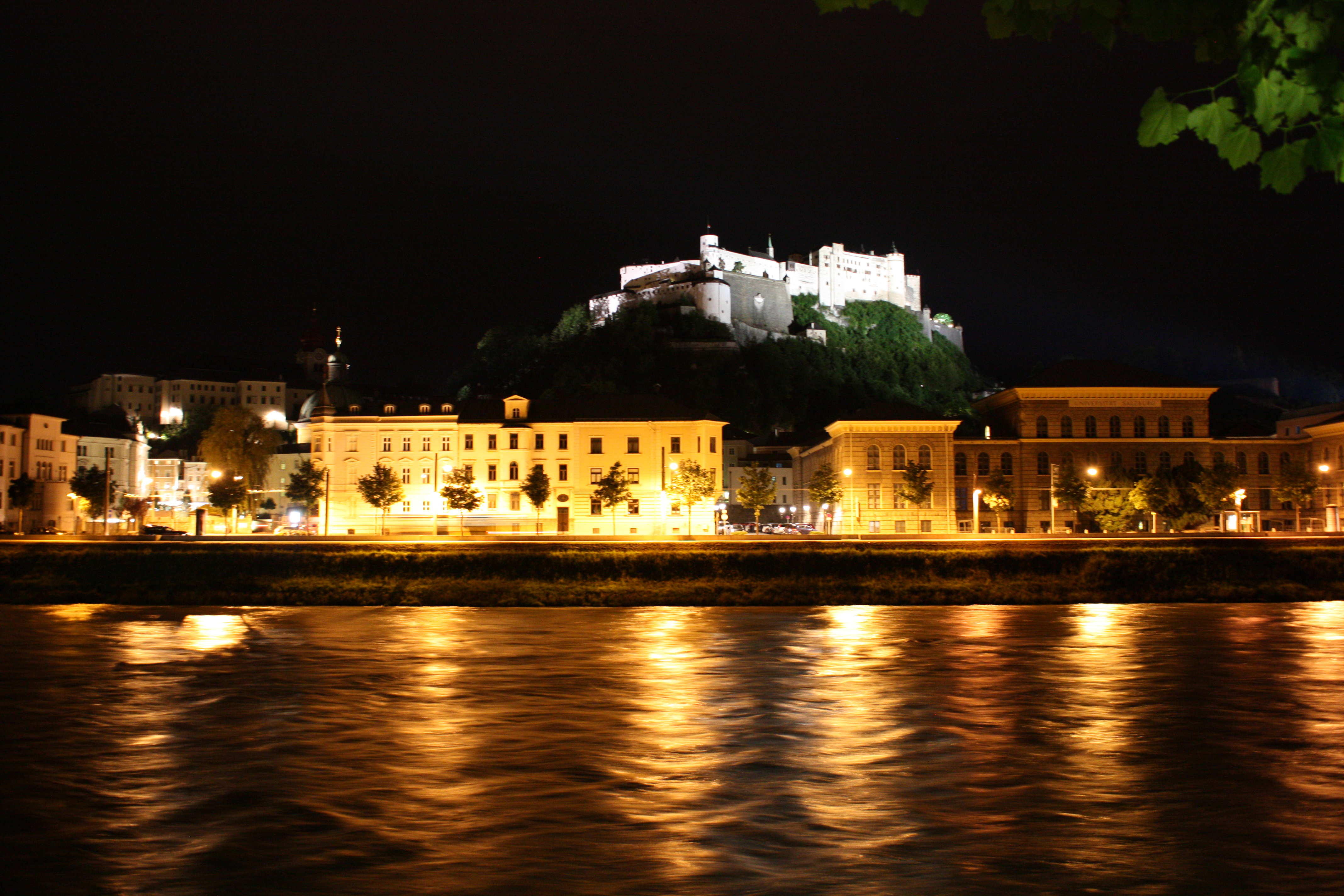
Our hotel was close to old town Salzburg and not far from the castle. As soon as we were checked in, they all suggested we go to Planet Hollywood for a PIZZA! A PIZZA?? …in Salzburg, Austria. I was shocked and disgusted and ditched those losers as quickly as I could.
I mean, I’m in Austria for Chrissakes. The last thing I wanted to do was go to an American Restaurant! I wanted to experience Austria as Austria, not an Americanized vacation version.
I enjoy trying new things and I think this particular trip is where that kind of started. I was in a foreign country and in my mind that meant you try the local food. Why would I fly halfway around the world to eat something I can get at home? What’s special about that? Who wants to hear someone brag about eating a pizza in Salzburg? No one! I want to hear about the bier and the wurst and schnitzel! The real Austria.
So, I set off to explore the city on my own. I barely spoke the language, had no idea where I was going, and my cell phone barely worked in the country. Yet, I had a new camera and a sense of adventure.
I ended up walking down to the river and getting some great pictures of the Mozart Bridge on the path along the bank. The area had an amazing Old World feel and I was soaking it up. Then I found a little bar/restaurant nearby.
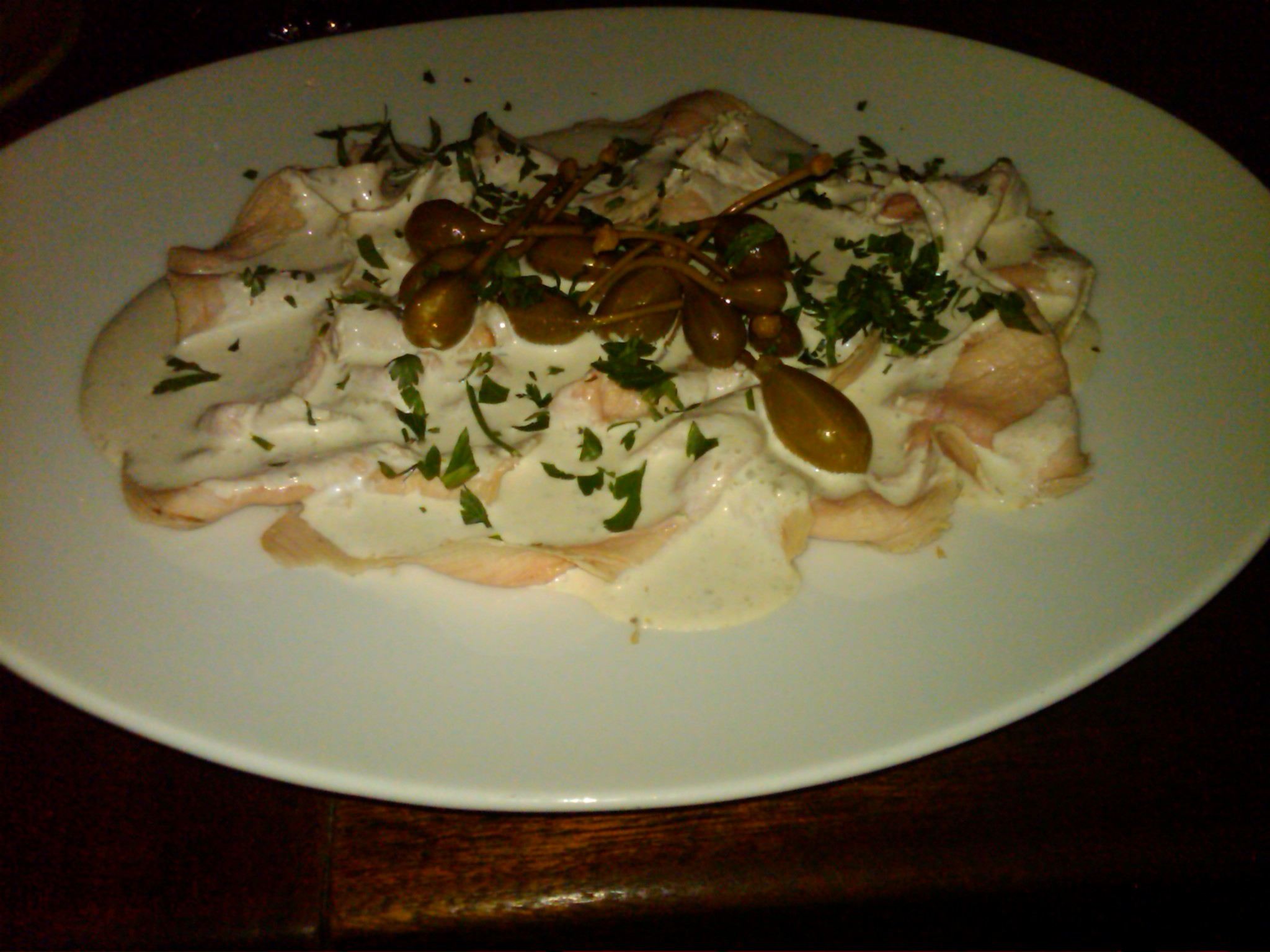
I sat at the bar and asked for a menu; it was in German of course. I wasn’t bothered because… adventure! I had no idea what I was ordering but I just pointed at something and ordered a beer. The beer was stronger than I was used to but lovely. However… dinner turned out to be a cold cream of tuna… “something”. I wasn’t sure what it was. All I could do was laugh at my situation. Of course, it was going to turn out to be something completely weird that I would never eat on purpose. And yet… it was delicious! It was by far the best mystery meal I have ever had.
I did save a picture of it. Maybe someday I’ll go back and find out what it is.
Now, I don’t recommend doing the random menu item trick. But… definitely explore the local cuisine. Travel to explore the world, not to experience what you can get at home. Foreign travel should never feel like a Disney version of a foreign country. It should be feel, sound, smell, and most certainly taste foreign. My wife and I like to go on food safaris to experience as much as we can. Even when we travel to new cities we want to experience it. We want to taste the local food and the local beer and eat at local restaurants. Foreign travel should never feel like home. It should feel like an adventure and new foods better be part of it.
Postscript:
After a search of my memory and Google Maps, I was able to actually locate the restaurant in Salzburg. Flavour…weinbar restaurant is still there and they still have the same dish on the menu. It turned out to be Vitello Tonnato, an Italian dish made with boiled veal in creamy tuna sauce which is served cold. I highly recommend it!
Our trip to Italy is a mere thirty days away and my wife is fit to burst! This weekend it really got to her and every once in a while she would reach over to poke me and squeal. She is SO excited!
Yeah, she is still a giddy schoolgirl at times and I appreciate it.
Our big task this weekend was to pre-pack our suitcases to finalize our wardrobe and accessory plans. Two pairs of pants, two shorts, swimsuit, three pairs of shoes, etc. along with all the expert travel accessories we’ve accumulated: vacuum pack bags for pillows, foldable spare suitcase for souvenirs, ponchos, adapters, etc.
We’ve done this a few times and we end up packing less and less each time.
We will check-in our large bag (only ¾ full) and our scuba gear bag. My carry-on will be a backpack with camera gear, guidebooks, and one change of clothes. Sheri will carry her backpack with travel details, laptop, all wires and adapters, and one change of clothes.
As I said, it is a month out from our trip. We do this so that we have time to order things we will need or, as in my case, time to break in the new shoes I just bought.
The basic fact is that I can buy almost anything I need on my trip at my destination. Why pack it all there only to pack it all back? Because, as Americans, we are trained to do it that way. We see our parents pack three suitcases for a week in the Ozarks. Movies display this kind of packing all the time, where the wife needs an entire bellhop cart for her luggage. It is ingrained in our images of VACATION! That is training is really hard to get over. But experience is starting win out.
In reality, I could go through the entirety of Europe with two pairs of shorts and a couple shirts. And as I get older and more experienced, I get closer to that ideal. Even now, as I write this, I feel the need to trim my packing a bit. I mean, how many pairs of underwear does a guy really need? Honestly?
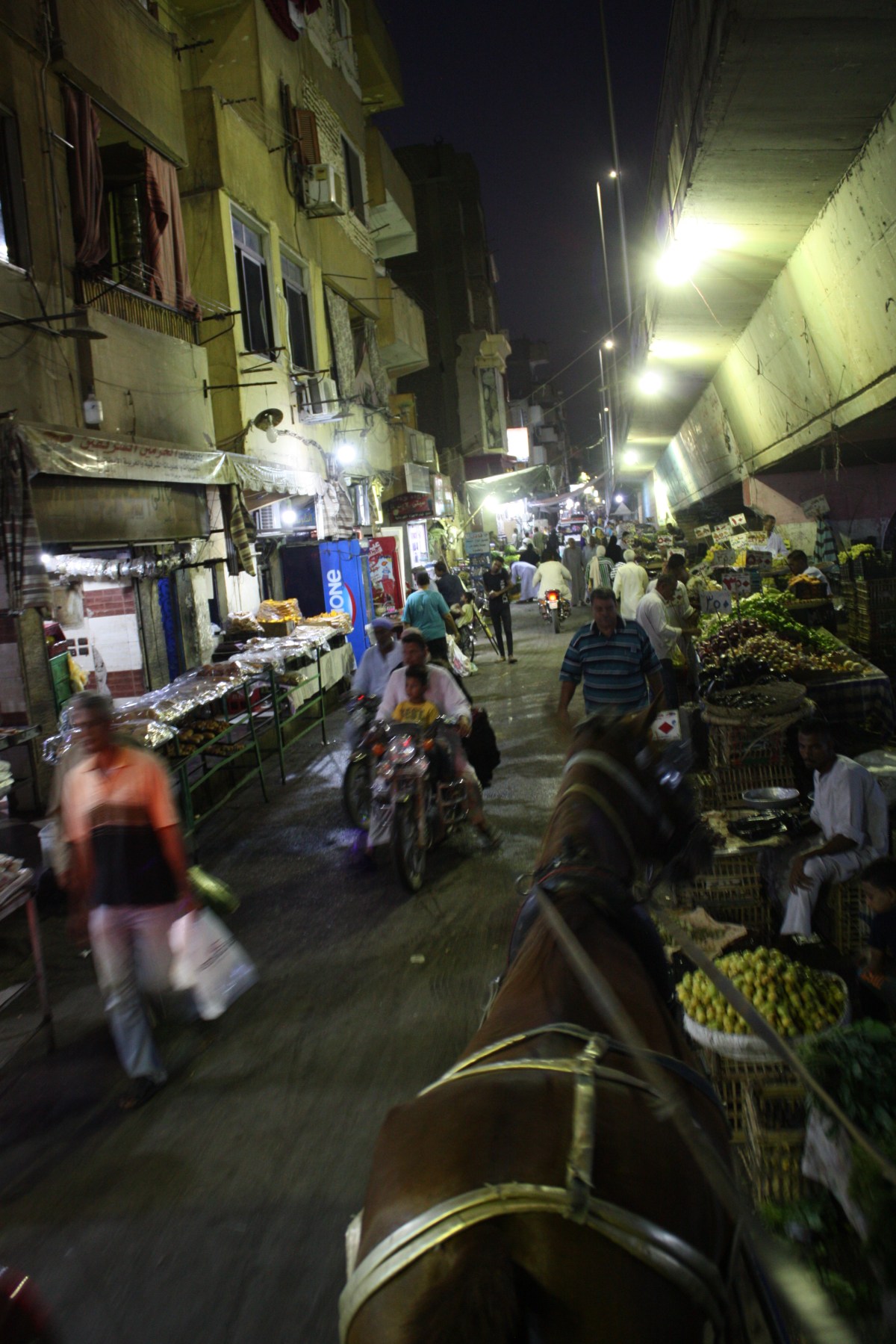
On the way back to the boat after touring the temples, our guide asked if we would be interested in seeing the nightlife of Luxor. Of course, we jumped at the opportunity. We were kind of dragging ass by this time, so we preferred an early evening tour rather than a true ‘late night’ excursion.
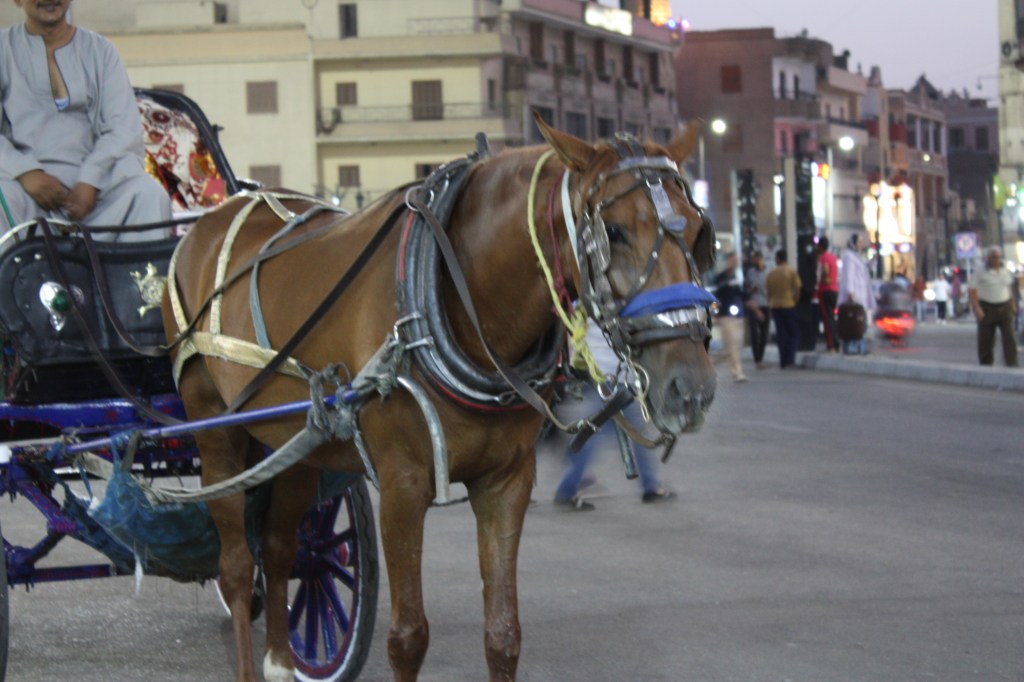
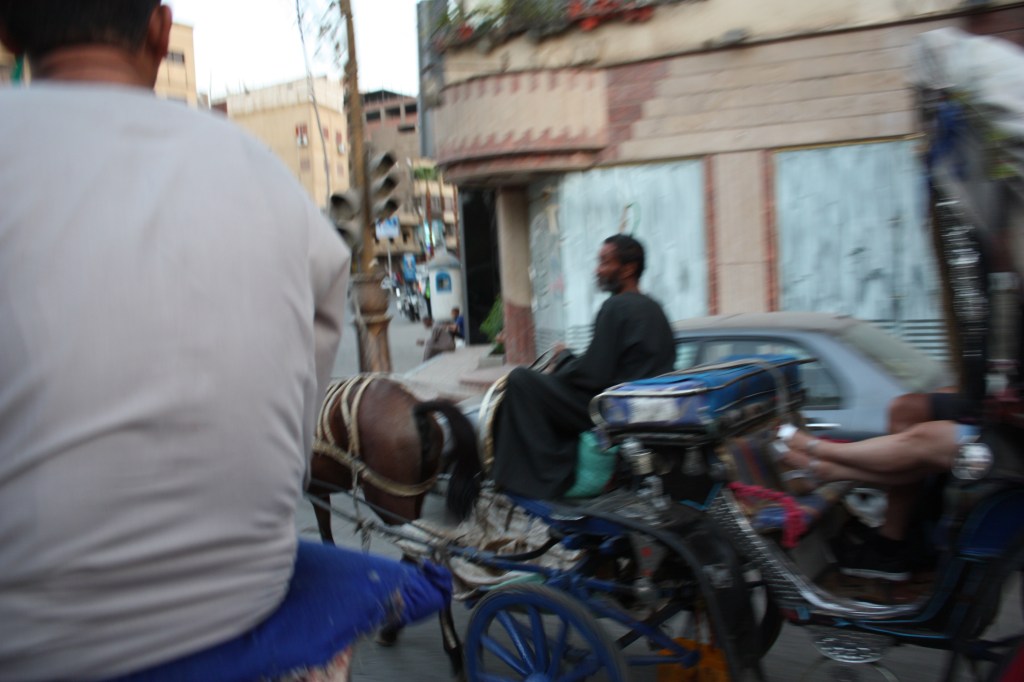
After dinner and a nap at the boat, we met him on shore where he had a horse-drawn carriage ready for us. There are hundreds of these carriages in every city that gets tourist traffic. They are cheap and can get you places just as easily as a cab and are easier to find than a cab. The wooden carriages seem to be straight out of photos from the 1800s. The large wheels a have layer of rubber on them to help with the ride on modern streets. And they are ALL DECORATED!! They are covered with buttons and painted flowers and patterns or with cut metal shapes riveted to the sides. Each carriage is a piece of art painstakingly created by the owners. These carriages are their livelihoods and they care about them like pets. The horses look miserable and haggard, but I imagine they are just as well taken care of at the end of the day.
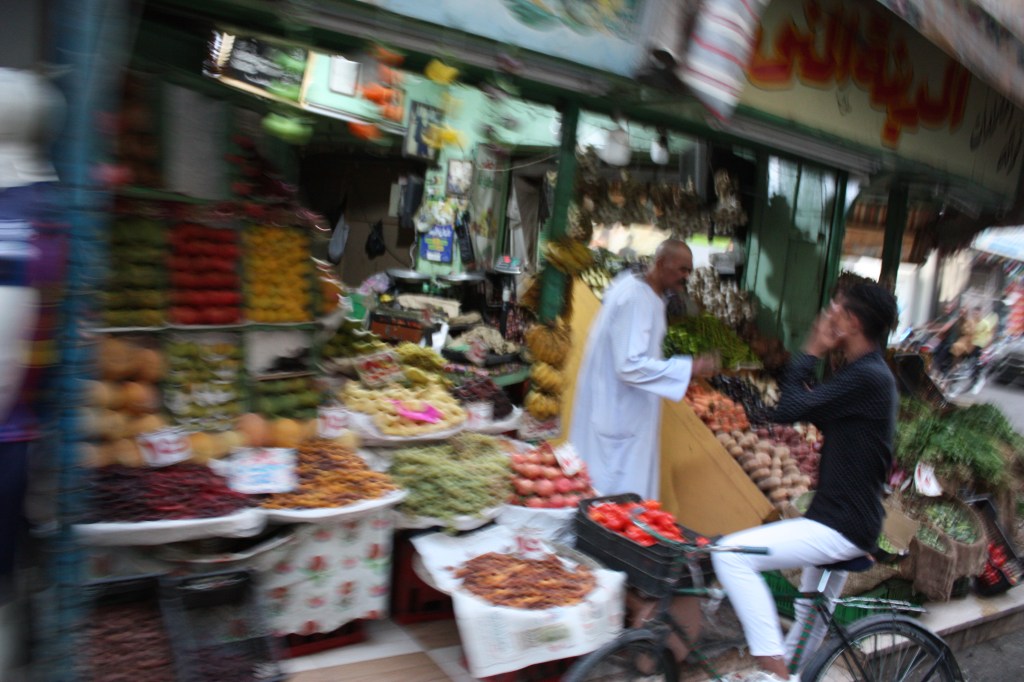
Our guide initially took us through the back streets of Luxor through the old town. Where the oldest buildings are located. Some of these are centuries old and still inhabited. These were also the poorest streets. I felt bad about gawking at their decrepitude, but I also wanted to experience the country, even the ugly side. For the most part, the streets were deserted with few people about. However, we soon saw why, everyone was down at the night market. It turns out that most Egyptians sleep during the day and come out to do their shopping and business at night after the sun has set and it’s cooler. Makes perfect sense!
When we went through, the market was not yet at full stride. It really doesn’t get going till around midnight and runs to till four or five in the morning. The streets through the market area were narrow and crowded. Sheri had been invited up to sit by the driver and steer the horse and, of course, jumped at the chance. She was excited until we got to the crowded streets, then she was all worried about running over someone.
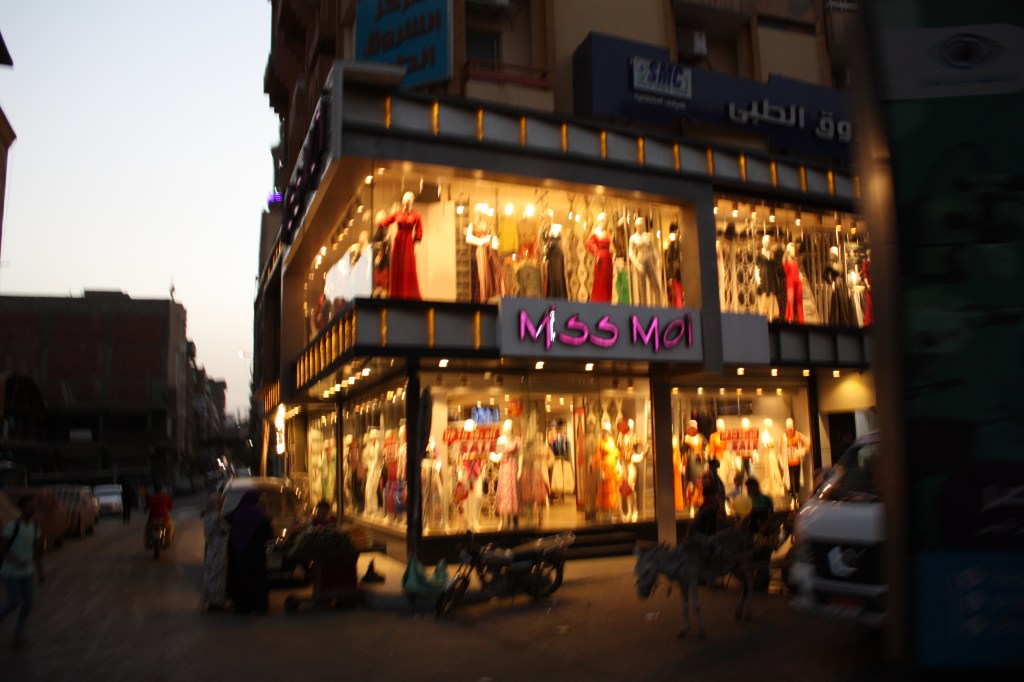
Our guide explained that Egyptian women love fashion as much as anyone else and one of the busiest and most expensive streets in the city was dedicated to women’s fashion stores. He offered to take Sheri there, but by this time we were both exhausted and called it a day.
I would have loved to explore the market on foot and check out the food market. One thing we failed to explore in Egypt was the local food. We usually make a point of it when traveling, but on this trip, we were rarely out and about in town. We ate most meals on the boat which did have some Egyptian-style options, but nothing I would call local. Next time, I want to explore that aspect of the culture more.
The entrance to the Luxor Temple feels much more complete than that of Karnak. There is the usual Pylon of stone on either side but with an obelisk added and two seated pharaohs guarding the entrance with two more standing pharaohs on each side. Luxor has so much more ‘stuff’ than Karnak. The reason for the difference is easy to explain.
Karnak is a shrine to the gods – Amun, Mut, and Khonsu specifically with a plethora of shrines to other gods added over the centuries. Whereas the Luxor Temple is specifically a temple to the Pharaohs and the yearly rejuvenation of their rule. So, it seems to me that the pharaohs went out of their way to make sure everyone knew what big powerful kings they were.
Ramses II
Obelisk
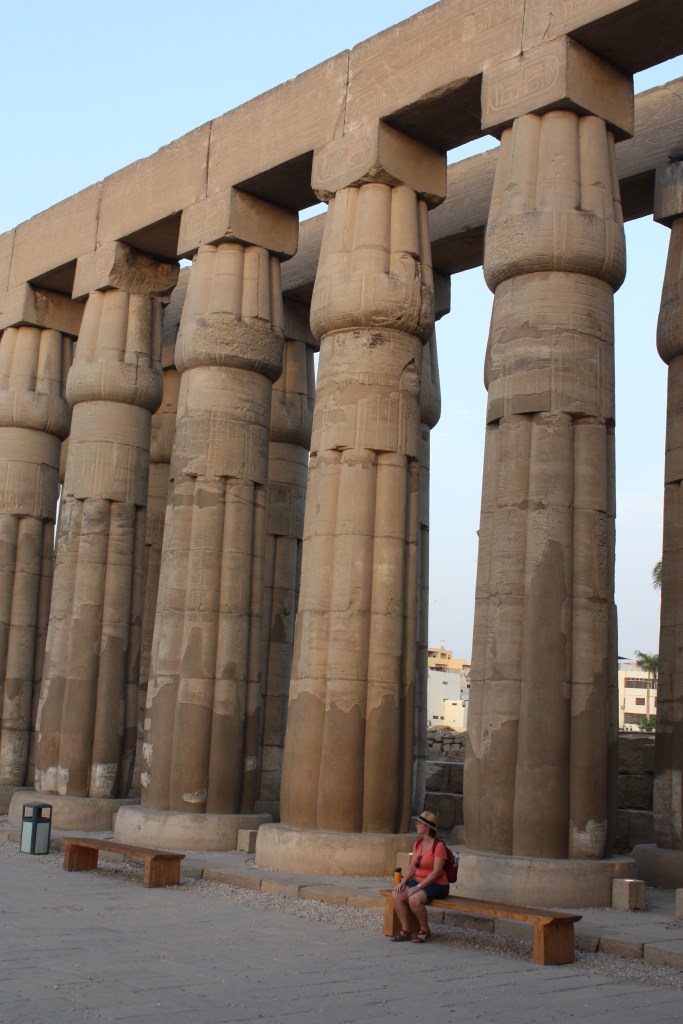
Ramses II in particular left his mark on the temple. He added the grand pylons at the entrance. The statues guarding the entrance, two seated and four standing, are stylized depictions of him. Ramses II also added the first courtyard with seventy-four Lotus bud columns and even more statues of himself. As I said, this is a temple to the Pharaohs by the Pharaohs – look how great we are!
At one time a grand scene of Ramses II going into battle decorated the Pylons. You can just make out the remnants of the carvings that were originally painted in bold bright colors. Also, there were originally two obelisks set at the entrance, but the smaller of the two was gifted to France in 1829 and is now in the Place de la Concorde in the center of Paris. We drove past it on our stop-over in Paris.
The city of Luxor was built on the ruins of Thebes, the ancient capital of Egypt. The power of the pharaohs was centered around the worship of the Gods at Karnak and rejuvenated every year at Luxor during the flooding of the Nile with the Festival of Opet. They were then buried in the Valley of the Kings across the river on the west side of the Nile. Thebes was the site of more than sixty festivals and feasts annually. It was the center of both religious and political power for centuries.
Alexander the Great recognized this and had a shrine built here after he conquered the country. He had his image stylized as a pharaoh and carved into the walls depicting him receiving his power from Amun. This is the Amun-Min version of the god with one arm, one leg, and a massive penis! On our visit, there was a line of people to see this carving. Apparently, massive penises are very popular with tourists!
Shrine to Alexander the Great at Luxor
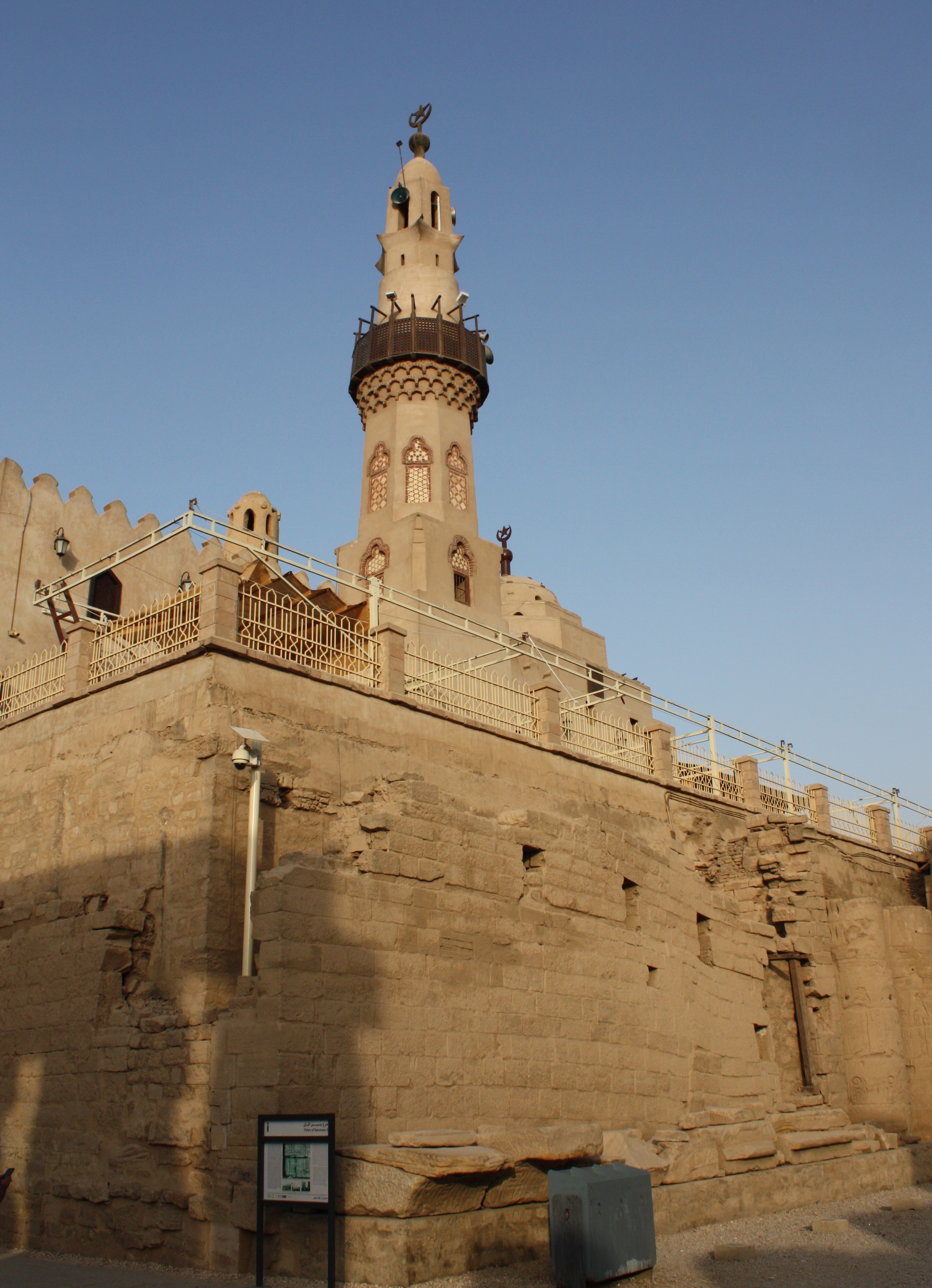
The Luxor temple complex has been an important religious site for more than 3000 years. The original temple was dedicated to Amun, the God of the Air. Romans used it as a church and monastery that was then converted into a Mosque that is still in use to this day.
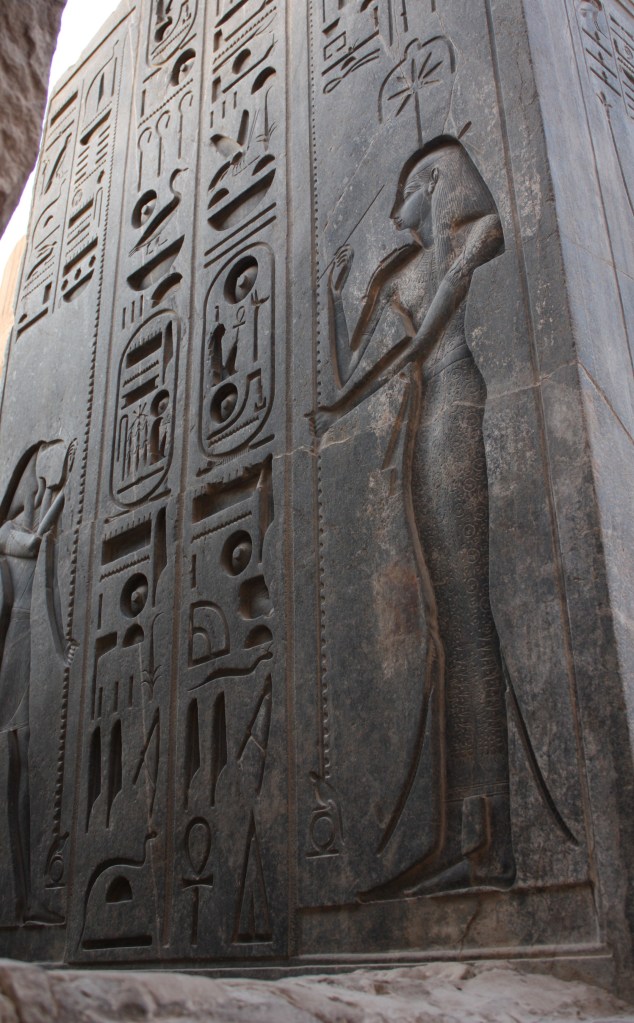
Our personal guide Ahmed knew that I was an engineer and writer. At Karnak, he pointed out the temple of Ptah – the god of architects and engineers. At Luxor, he showed us an image of the goddess of writing and knowledge – Seshat. (My new favorite goddess.) The image is carved into the back of the throne of one of the seated Ramses II statues inside the temple. You would never notice it unless someone pointed it out.
The central aisle through the galleries will take you to the most important room in the temple: the room where the god’s barq was kept. They have a replica displayed inside, but again there was a line to peek in and no lighting, so it was impossible to get a good picture of it.
All the professional guides in Egypt are required to be Egyptologists. Seriously, they are experts at the stuff. Our guide, Ahmed, had a PhD in Egyptology. When we visited the temples, he flooded us with information. The history of the sites and the narrative of the stories carved into the stone is so vast that it would take a PhD to absorb it all. We did our best to retain and understand as much as we could, but it did not take long before it was a blur of names and symbols. This was when I stepped away and began just looking for great photos.
Ancient temples and the world’s tourists surrounded us. I was literally eating up the culture and the atmosphere. I loved it. I took hundreds of pictures here and got my first taste of the monumental architecture of Egypt.
As an avid photographer, I love looking for the perfect picture of a scene. I tend to see what I want in my mind’s eye and then attempt to recreate it. Egyptian temples are a treasure trove of photo ops. I love a good space and the massive stone construction provided some great shapes and shadows to work with.
In the back corners of the temples, you will run into locals that have staked out prime locations and will point out extra special photo ops for a few dollars. I am sure they make a pretty good living during the tourist season.
When I travel, I like to step away from the group to explore and absorb the atmosphere of a place. I did that here. I avoided touching any carvings, but not everyone is so careful. However, I did place my hand on the rock of the temple and even hugged one of the massive columns. I always hope to feel something – such as an energy reaching down 3500 years to somehow connect with me. There was nothing there to feel, but it was still thrilling to be able to place my hand in the same place another person had touched hundreds of generations ago.
That is how travel can really put your life into perspective. Compared to the age of this place, my life is a grain of sand. How could my daily stresses mean anything in comparison?
Our first thought on entering an Egyptian temple was: Damn that’s big! Particularly when you realize that everything is built of cut stone and with manual labor. Massive props to the engineers and workmen!
As an engineer myself, I tend to analyze the possible building techniques before I even notice the art and aesthetics. But beyond the amazing architecture, they are beautiful, well-built structures and I was duly impressed.
Our first temple was Karnak, one of the most iconic Egyptian temples. This is the most visited temple after the Pyramids at Giza. Karnak has appeared in many movies and is usually the one pictured when they want a generic ‘Egyptian temple’ in the media. However, what they don’t show is that the temple is right next to the river Nile and surrounded by a modern city.
Both the Karnak and Luxor temples are located in the city of Luxor and most of the economy is driven by the tourist trade generated by the temples.
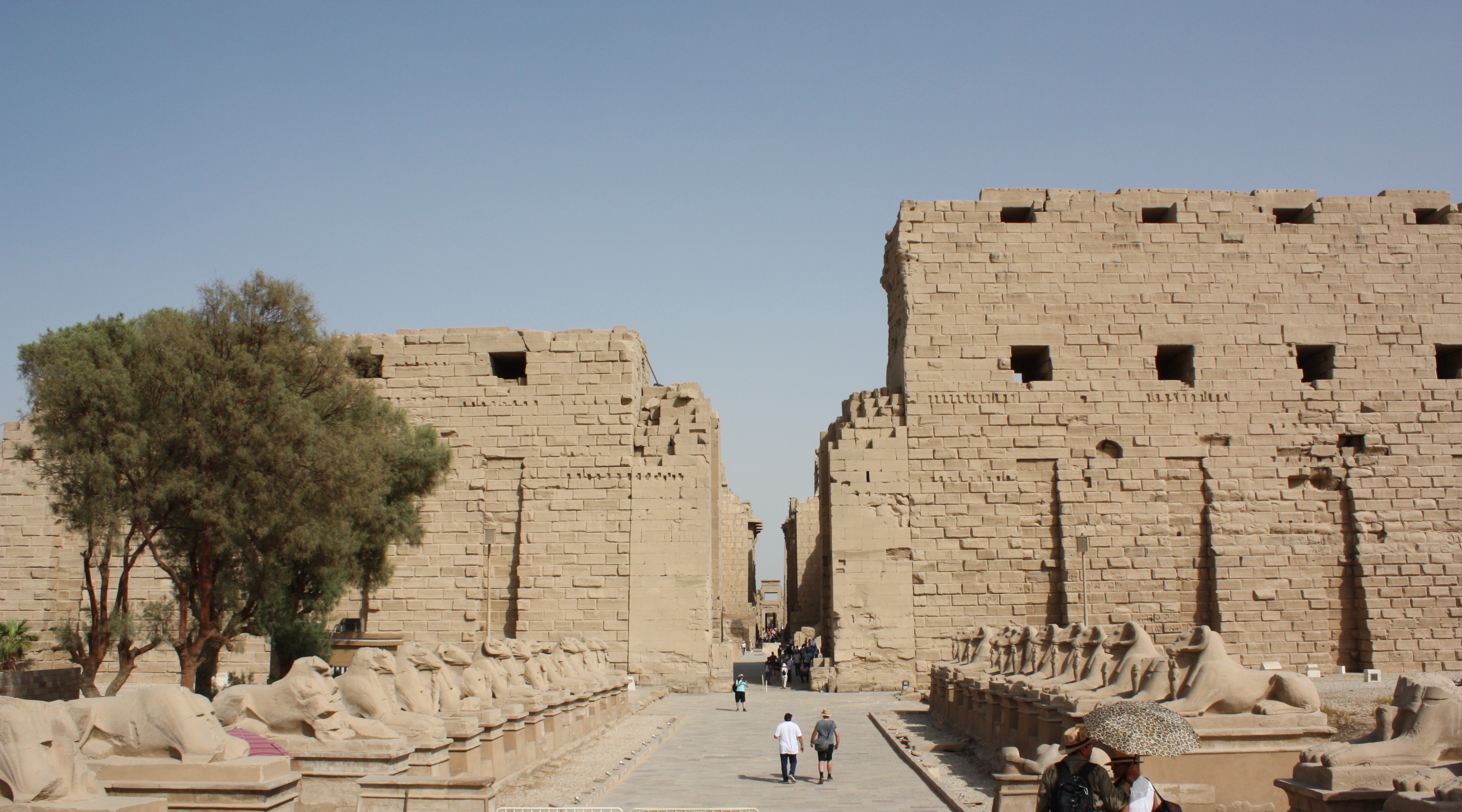
Our first approach to Karnak was down the Avenue of the Rams, which appeared in one of my favorite movies: The Mummy Returns (2001). The first thing you notice is the different heights of the two pylons of the gate. These were a late addition to the temple and ultimately unfinished and undecorated. The remains of the mud-brick ramps used for construction are still in place. This detail got me pretty excited. …Engineering-nerd, what can I say.
The temple is dedicated to the worship of the god Amun, the sun god, and was added onto for over a thousand years.
During the Opet Festival when the Nile floods, a statue of Amun would be carried on a symbolic barge from the temple of Karnak down the Alley of Sphinxes 3km to the Luxor Temple where he would be ceremonially married to the pharaoh, thus promoting the fertility of Amun and the pharaoh and all of Egypt.
The Alley of Sphinxes is still extant and walkable. I was unable to talk my wife into the hike, so we were shuttled to the Luxor, just down the road.
The Temple of Karnak is iconic and absolutely beautiful, and yet a little of a letdown. This is a working tourist site and has a worn-in and trampled feel that can take away from the experience. However, I found that I could ignore that and turn my mind inward to experience the atmosphere. I could almost feel time hanging in the air like cobwebs.
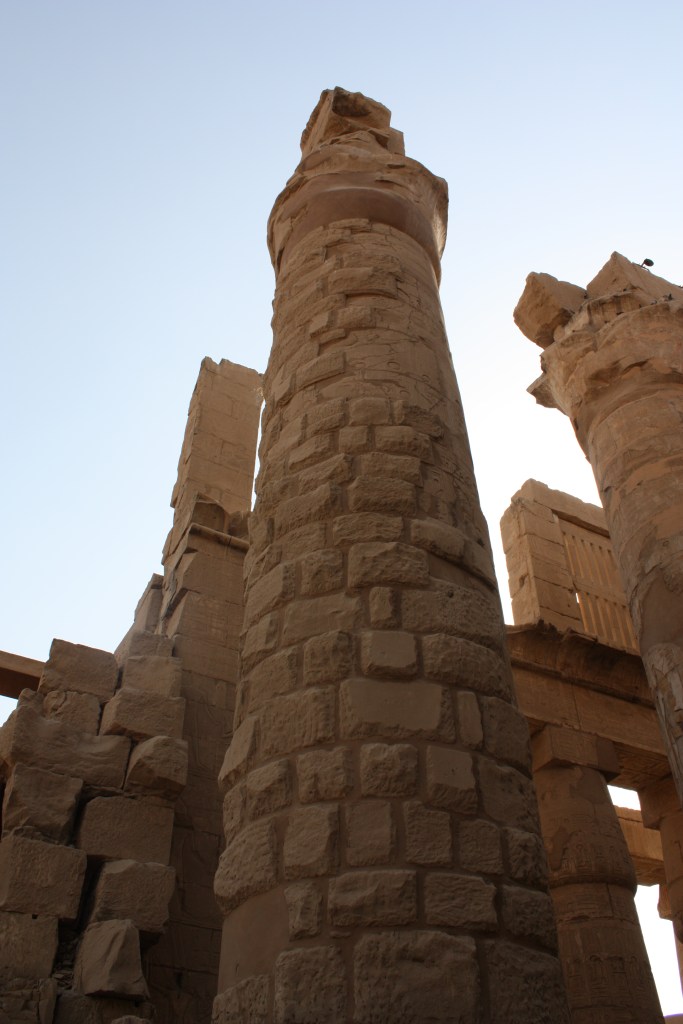
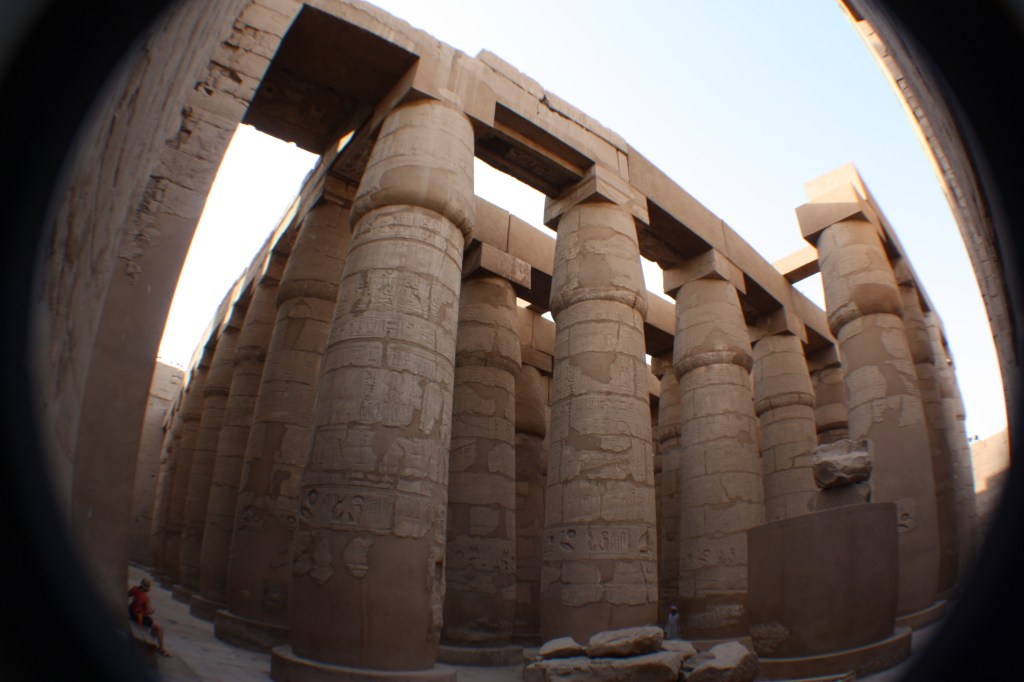
The most famous and photographed part of Karnak is the Great Hypostyle Hall. It is 50,000 square feet of COLUMNS!! I love me some columns! Karnak is a column farm. 134 of them. Most are 33 feet tall with another twelve 70 feet tall! There are several examples that are not completed showing how they were constructed. The unshaped rock was stacked and mortared into place, then craftsmen shaped the column, followed by artisans that would carve the art and hieroglyphs into the stone. Finally, everything was painted in bright colors. Most of the paint is now faded and gone, but there are places where it can still be glimpsed.
At Karnak, I first encountered the ramps used in the construction of the temples. For some reason, these are never mentioned in any of the books I’ve read. The stones were cut, roughly shaped, and placed on barges at the quarries in southern Egypt. Then when the Nile flooded, the barges would be floated down the river and into preconstructed canals leading right up to the building site. They used the same technique for the pyramids. Amazing engineering!
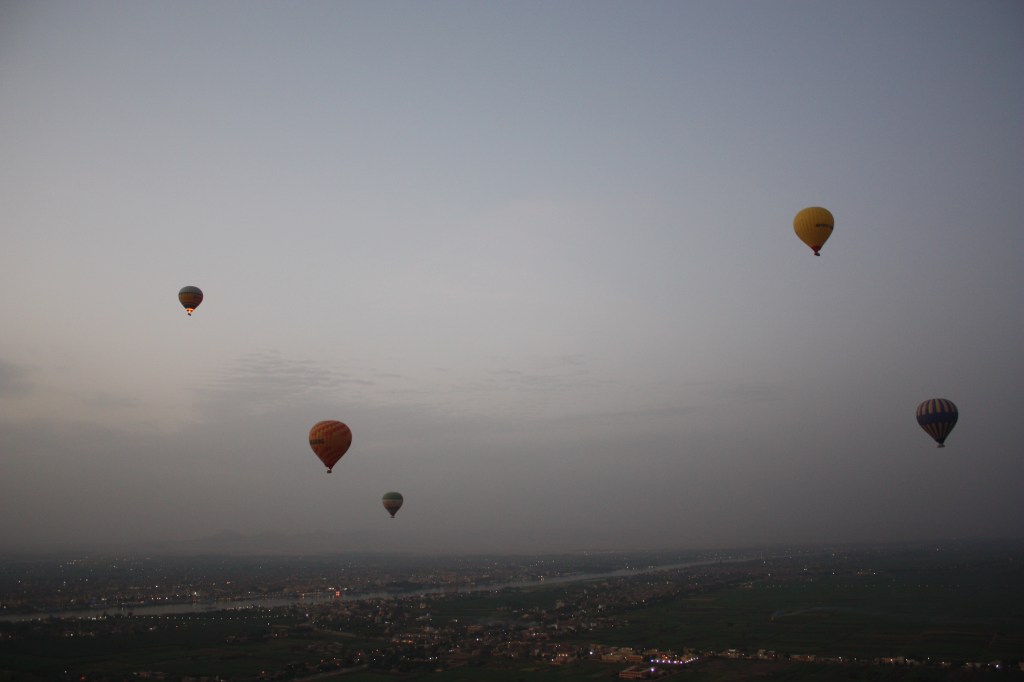
Our first full day in Egypt began with a boat ride across the Nile at 4:30 in the morning! We were to welcome the dawn from the basket of a hot-air balloon over the Egyptian desert. We’ve always wanted to go up in a balloon and when Sheri found out that we could do it in Egypt, she jumped at the chance. The worst part of the experience was that it was so early after arriving in Egypt. We were still suffering from jet lag and were a bit punch drunk from the international travel experience. But we weren’t going to miss this for anything!
Of course, the balloons are popular and we were part of at least a hundred people on this particular morning. There was an entire field of them going up at once. Watching fifteen feet of flame shoot up into the night is pretty exciting. I took hundreds of pictures on this trip.
The baskets are large and hold sixteen or twenty people at a time, divided into little compartments. The pilot is in the middle surrounded by tanks of propane. The tanks don’t last long and he changes them out quite often. The balloon pilots are actual trained pilots with uniforms displaying their wing pins. Our pilot was very professional. Sheri and I were placed directly next to him and got to watch as he worked his magic.
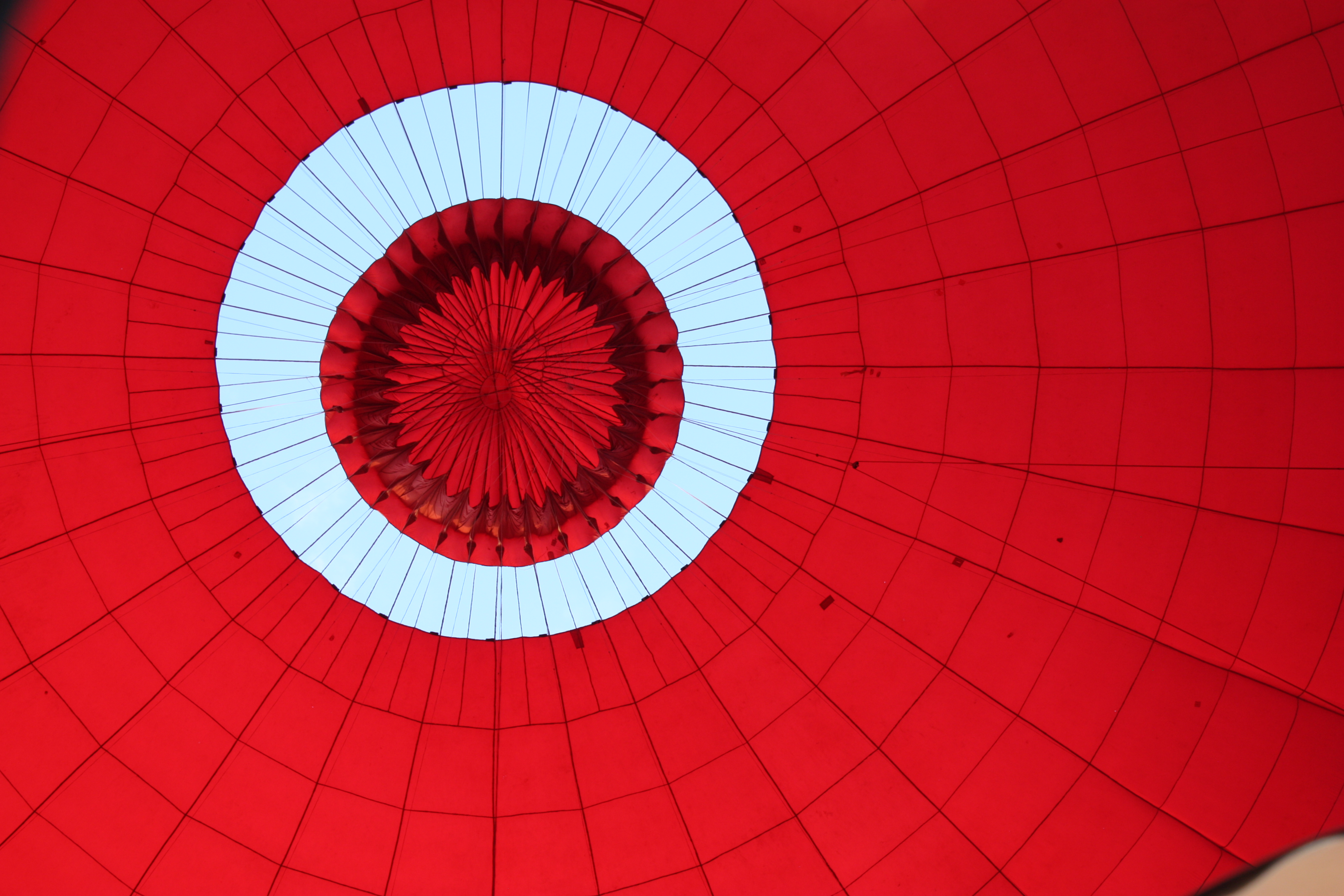
The flame was directly above us and HOT.
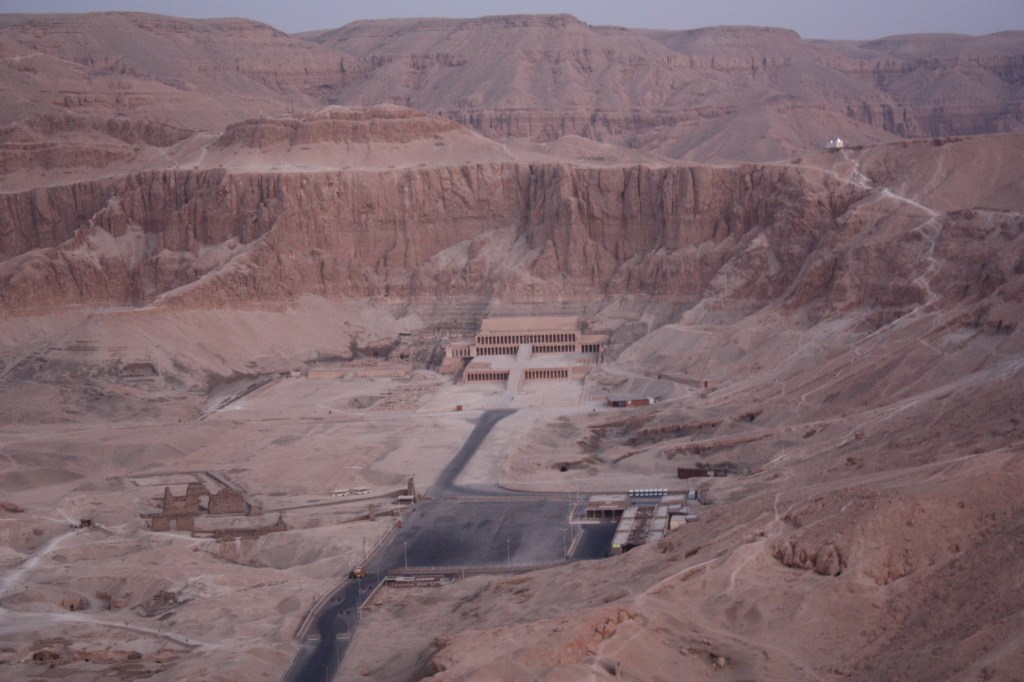
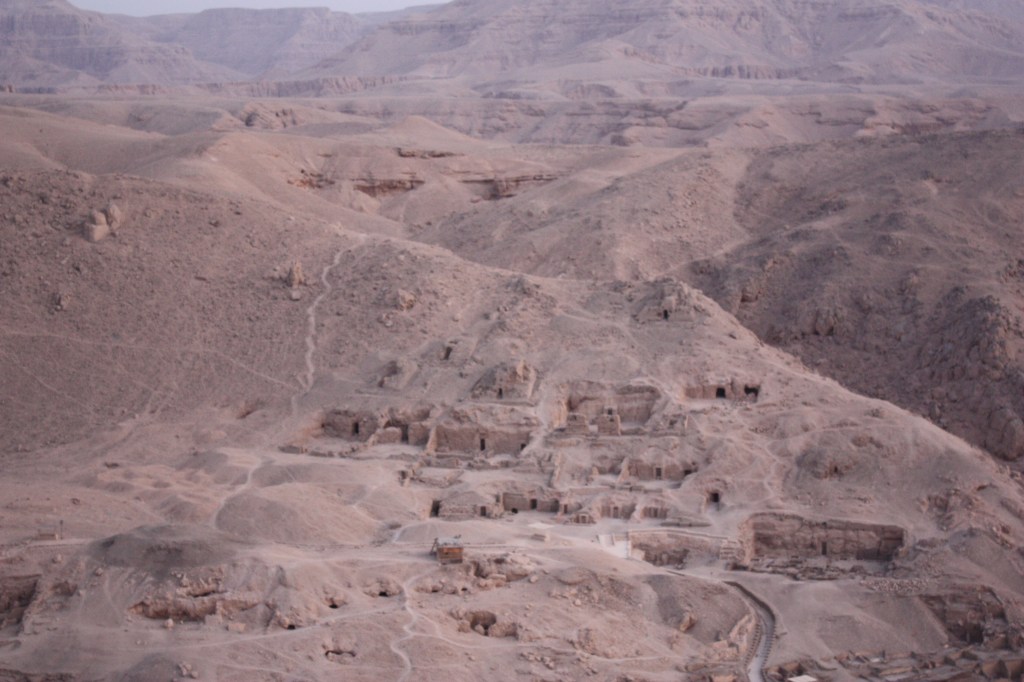
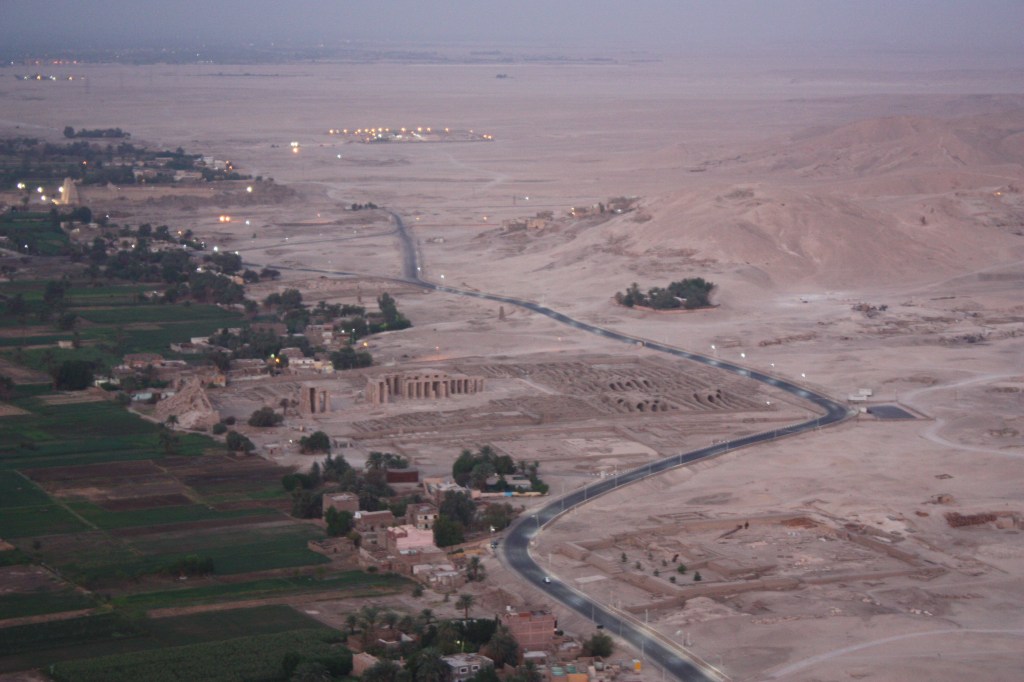
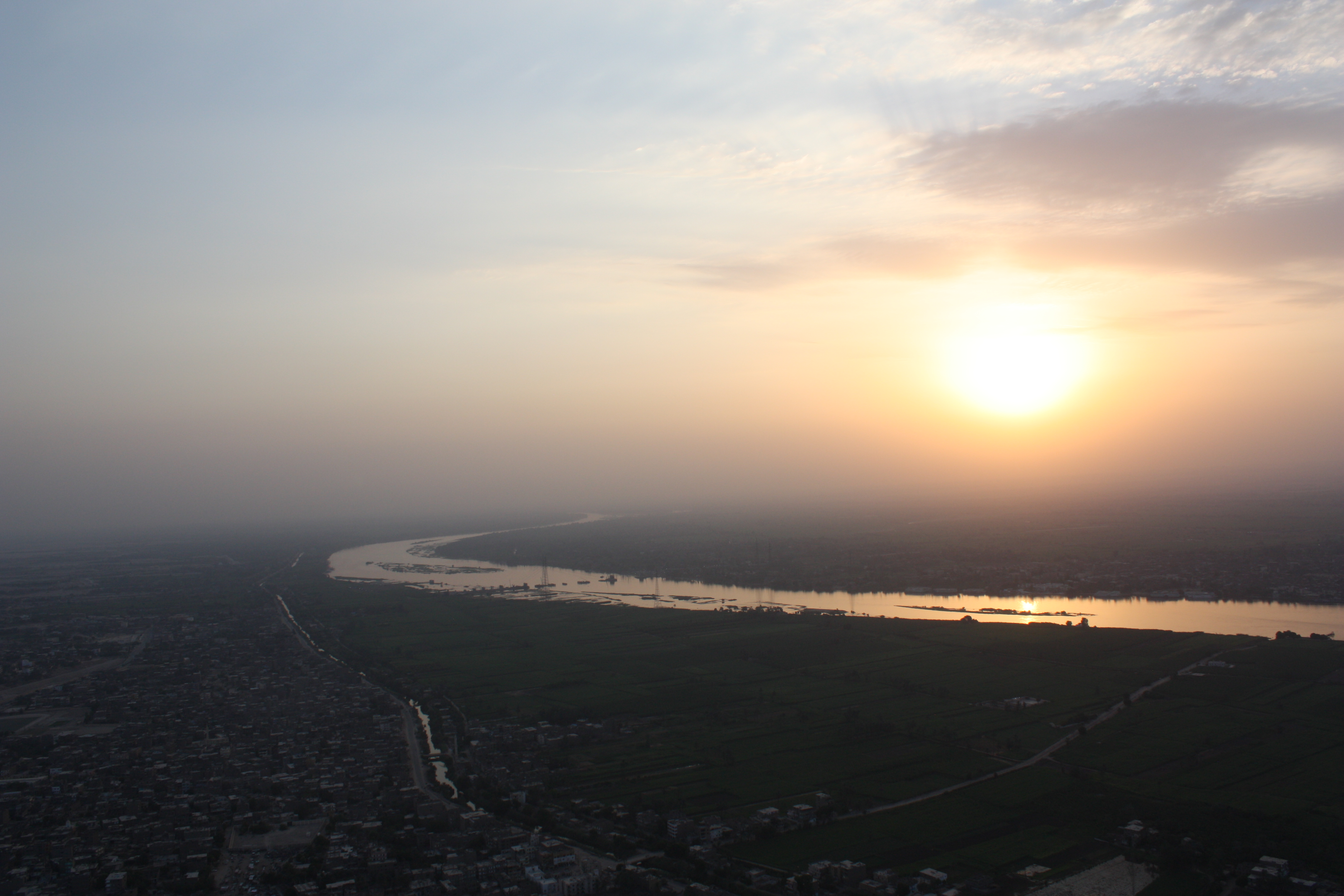
From the balloon, we could see the Nile twisting through the country with a narrow band of green fields on either side. West of us was the Valley of the Kings and the Temple of Hatshepsut.
In the hills, we could see openings cut into the rock. Were they ancient tombs waiting to be explored, but off-limits to tourists? It made me muse on what wonders we are not allowed to see?
From our height, we were able to look down onto some of the local houses and businesses. There on the edge of the desert life is clearly harsh and hasn’t changed all that much in 3000 thousand years. There were more carts than cars and more donkeys than bicycles. But even then it seemed peaceful and content. The lack of noise that surrounds us in our normal life was stripped away at that height and it was both exciting and calming.
Even with a pillar of flame above me, I found peace and contentment in the sky above Egypt. Part of the allure of Egypt is what we imagine is there but aren’t able to see. We conjure up cities of ruins under the sea of sand and hold our breath as we round each corner.
But the grandeur we seek is long gone, only the vestiges remain among an impoverished populace that sells access to the illusion. I don’t blame them for it; this is their inheritance. But I am nostalgic for what we’ve lost.
The Nile is such an iconic river it would be difficult to live up to its vaunted reputation. For me, it has been the subject of decades of history lessons, bible lessons, favorite movies, and books. So, of course, it didn’t live up to its image.
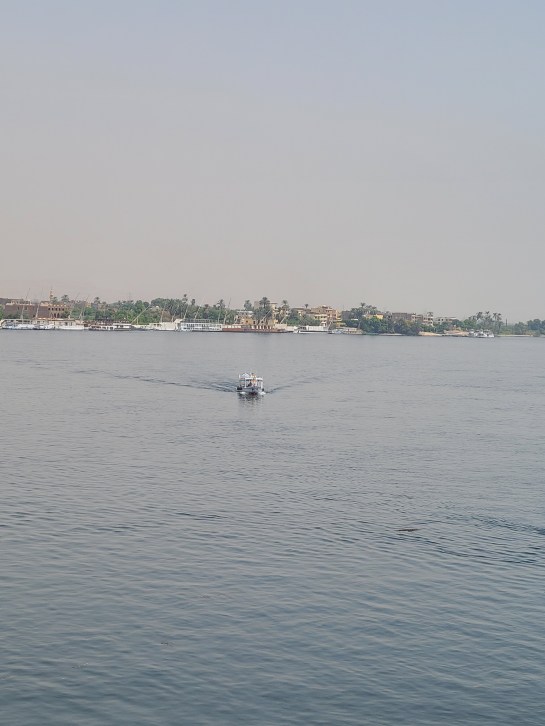
The Nile is much narrower and calmer than I ever expected. It is a wonderful small river; clean enough for swimming and fishing. Unlike American and European rivers, the Nile is not very industrialized. In our four days on the river, I never saw a barge or a factory. There was a small amount of trash along the shore, but it was minimal compared to what I’m used to.
I expected it to be much wider. It’s narrow and clean.
I live in St Louis, Missouri, USA, right on the Mississippi, which is an industrialized and sick river. I would never swim or fish from it. Which, made the Nile such a surprise. There has been a civilization along the Nile for thousands of years and you would expect that to show in the river itself, but it doesn’t. It’s as if the river washed all those years away, leaving the land clean and natural again.
The land along the river is extensively farmed but by small family plots. We didn’t see any industrial farming as we see in the US. There was no large farm equipment at all; people still used donkey carts and manual labor to work their fields, just as their ancestors did.
The country is extremely poor and much of the population barely gets by. Many of the homes we could see along the shore were simple and crude. However, everyone smiled and waved. They genuinely wanted us there because tourism is really the only economy in Egypt.
When we scheduled our Nile cruise, we imagined a lone boat making its way along an isolated desert shore. But the ships work the same itinerary, so they cruise as a pack, parking side by side at the dock and allowing passengers to pass through to the shore. It was surprising, but I can see the logic.
The Nile is smooth and navigable, making the trip perfect for anyone that gets seasick. There was almost no movement of the deck.
We were on shore touring the sites in the morning and early afternoon. The boats leave the dock in the afternoon and usually cruise through the night. The observation deck was ideal to watch the procession and the night shores glide by. The air smells different in Egypt, clean and fresh compared to home, with a little hint of sand.
The Hollywood image of the Nile is far from its reality. It is a beautiful river flowing between lush green shores bordered by bare rocky hills behind. The valley of the Nile narrows in places to only a narrow shore before the desert pushes in. Most of the Nile valley is wide and green, extending for miles into the desert, proving that the Nile is still the lifeblood of Egypt and will lead you to adventure.





































 So Many Words...